
ACE Montessori · Blog

Work or Play? A Peek Inside the Montessori Classroom.

A guided tour of a Montessori day: arrival, the long morning work cycle, friendships, and the role the adult takes in the room.

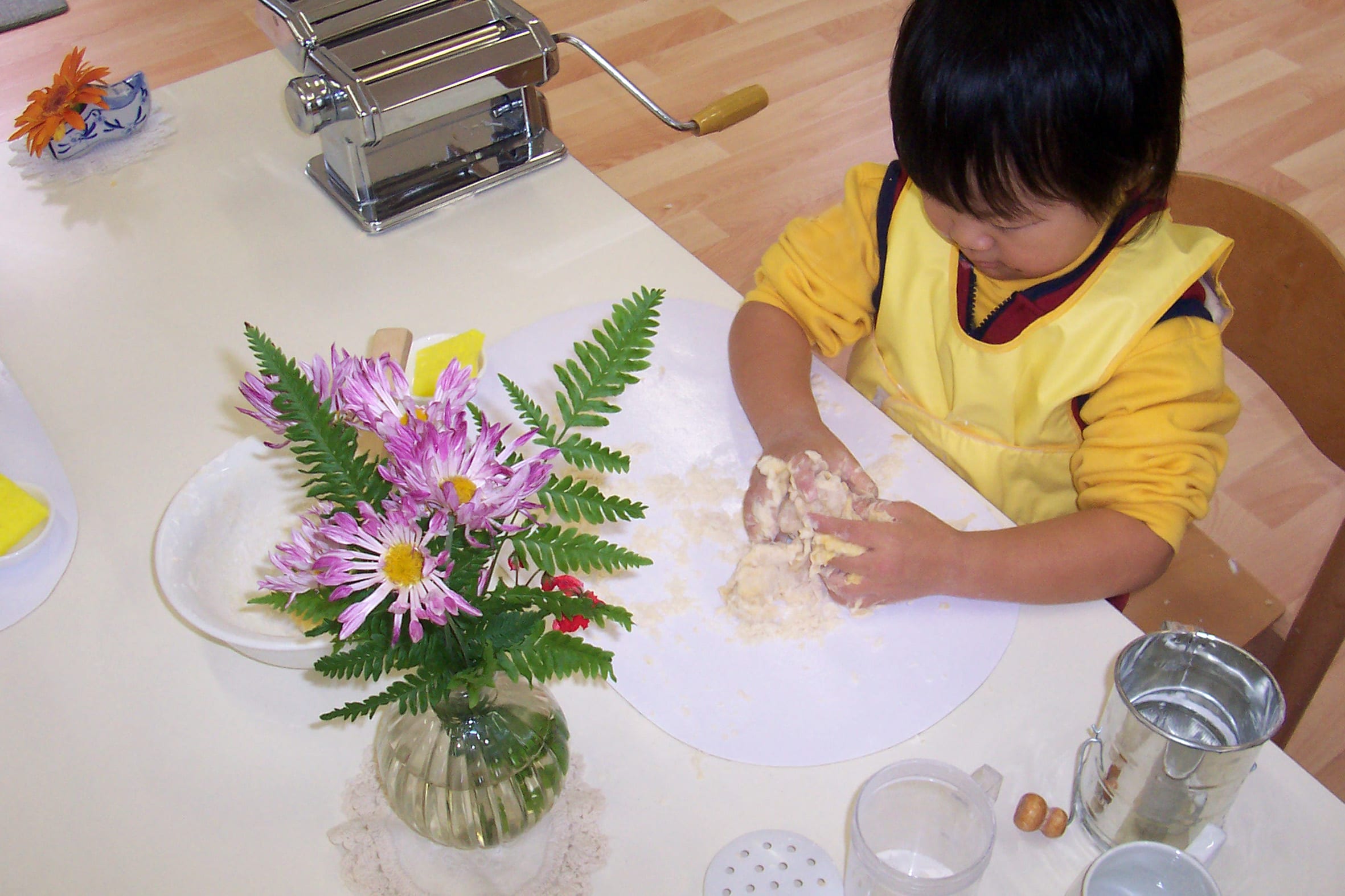
A young Montessori child in Australia kneads dough at a practical-life work station with a small flower arrangement beside her.

Visitors arrive at Montessori with all kinds of preconceptions. Some have heard the room is anarchic: children doing whatever they like. Others have heard the opposite: that the structure is so rigid it snuffs out anything that looks like a child being a child. Neither version is right. Here’s what a Montessori day actually looks like, hour by hour.

A walk through a Montessori day

Arrival

The first few minutes of a Montessori day already look different. From the door, toddlers and three-year-olds alike are expected to hang their own coat, swap their outdoor shoes for the indoor pair the classroom uses, and put their bag where it belongs. We do this partly to keep our floors clean, and partly because every child who manages those small jobs walks into the room a little more capable than they walked in the morning before.

The guide meets each child with a handshake, eye contact, and a quiet "good morning, [name]" every day. It looks small. It isn't. We are modeling, in slow motion, what a respectful adult interaction looks like, and within a few weeks the children begin offering it back, first to us, then to one another, then to strangers in the grocery store.

The Work Period

What outsiders call "class" we call the work period, and it is the structural heart of the day. Children need long, uninterrupted stretches to settle into anything deeply; so we give them that, every morning, without exception. For children from age three up, the work period runs about three hours; for the youngest toddlers it is shorter, and elementary children typically have a second cycle in the afternoon.

During this stretch the children work independently while the guide moves quietly from child to child giving lessons, sometimes one-to-one, sometimes in small groups. To a visiting eye it can look like play, and in places it genuinely is, because certain kinds of play are how young children learn. But much of what looks like play turns out, on closer inspection, to be Dr. Montessori's carefully designed materials at work. A puzzle-shaped object is a biology diagram. A set of beautiful colored beads is a tool for grasping decimal arithmetic.

Inside the work period, the child gets real choices. They pick where to sit: a table, a floor mat, a quiet corner. They walk to the shelf, to the bathroom, around the room when their body asks for a stretch, without raising a hand. They decide whether they want to work alone or with someone. Adults expect that kind of autonomy at work; we believe a four-year-old deserves the same respect.

On any given morning, in the same room, you might see children working on:

  • Math
  • Language
  • Biology
  • Geography
  • Practical life
  • Sensorial refinement (through age 6)
  • Geometry

Socializing

Montessori is, at its core, an education of the whole child and a great deal of the whole child is social. The freedom-of-choice structure of the work period is itself a social tool: children decide whether to work alone, alongside, or together, and they begin to notice which of their classmates make good working partners and which make wonderful playmates outside of the work cycle. Those are not the same skill, and learning the difference is one of the quieter, more important things that happens in our rooms.

As children move into the elementary years, friendship takes on real weight. They begin to puzzle out, deliberately, what a healthy friendship feels like, where loyalty fits, what to do when someone hurts their feelings. And every child, at some point, hits the wall of social conflict. We do not shield them from this, we walk them through it.

Guides teach mediation, inclusivity, and conflict resolution explicitly, both before friction has occurred and in the moment it does. We use stories to model the patterns we want children to recognize, and role play to give them safe practice at responding well. By upper elementary, children are often resolving disagreements between themselves before an adult notices anything happened.

The Guide's Role

Visitors sometimes ask where the teacher is, and the answer is part of the philosophy. We don't call our adults teachers; we call them guides, because the work is closer to mountain guiding than lecturing. The guide doesn't deliver content for the children to absorb. The guide prepares the environment, opens a door, hands the child the tools, and walks them in.

In the primary years (ages three to six), almost every lesson is given one-on-one. That lets the guide give the child their entire attention, calibrate the pace to that specific child, and notice the small wins that drive everything else. In elementary, lessons are usually given in small groups, because children of that age are wired to work shoulder to shoulder with their peers.

One of the harder judgement calls a guide makes, dozens of times a day, is when to step in and when to step back. The default, well-grounded in decades of observation is to step back. Children rise to what we believe they can do, and they tend to surprise the adults who give them room. That trust is where the famous Montessori confidence comes from.

And the guide, always, is observing. We watch closely: what each child has mastered, what they are working on this week, where they are stuck, who they were sitting next to during the hard part. We write a great deal of it down, because the notes inform tomorrow's lessons, the parent-teacher conference, and the long arc of how a child is developing.

A guide never thinks of themselves as the centre of the room. The children are the centre. We are there to make that possible.

Come see a work period for yourself.

The fastest way to understand the difference between a Montessori classroom and a conventional one is to stand at the door of one for twenty minutes. Join our waitlist and we’ll arrange a visit.

Or call 905 472 9899