
ACE Montessori · Blog

Montessori Basics: The Language Curriculum.

How children learn to read, write, and think about words the Montessori way.

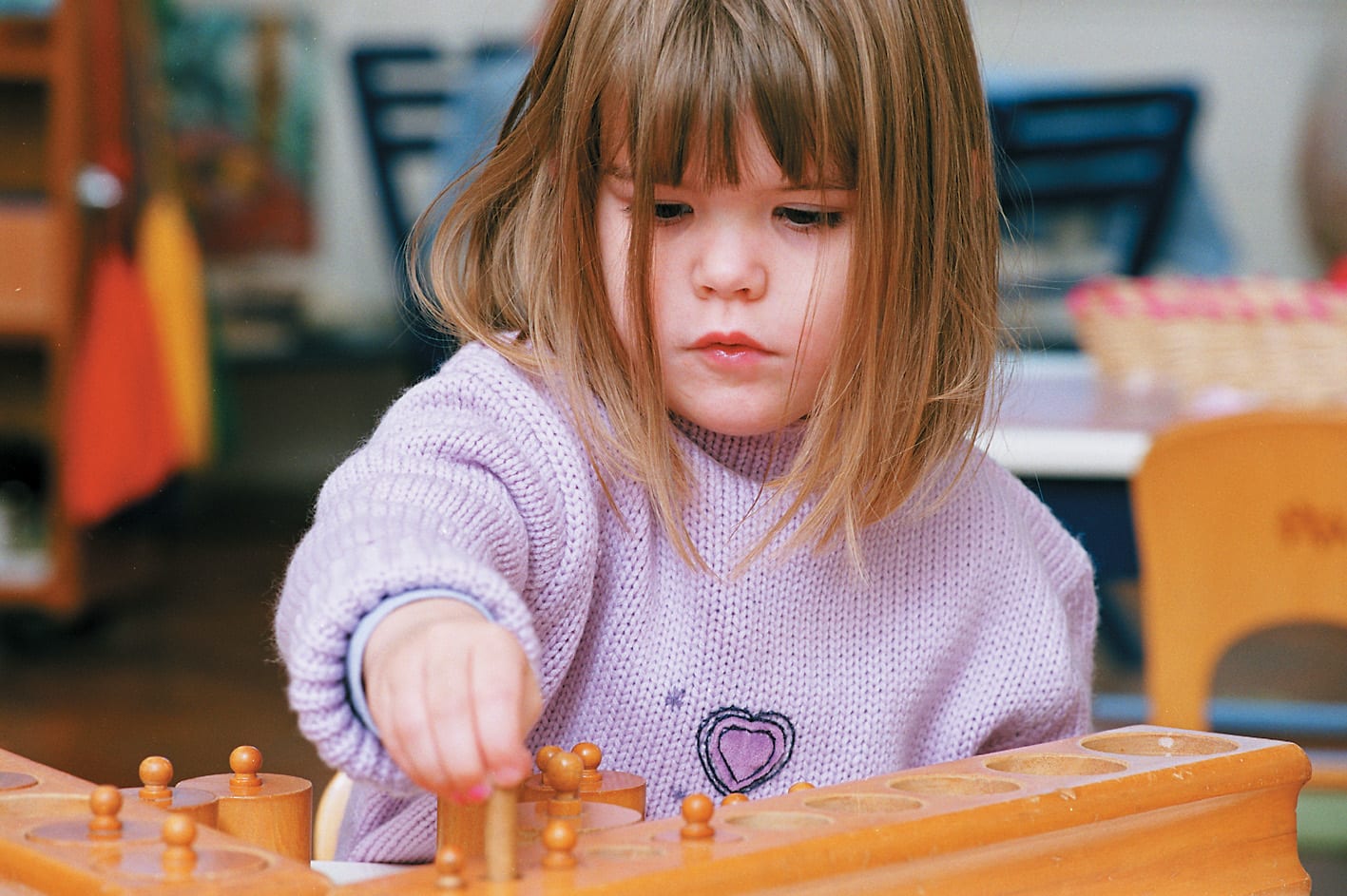
A young child in a Montessori classroom in the United Kingdom places knobbed cylinders into their wooden block, concentrating closely on the work.

Parents who watch a Montessori classroom for the first time are often startled by, How early and How naturally children begin to read. There is no trick to it, and we’re glad to walk through how it works.

The Montessori language curriculum, section by section

Where Language Begins

A child's relationship with language doesn't start at the classroom door. Dr. Montessori described the first six years of life as the era of the absorbent mind: a period when a young child takes in the speech around them effortlessly, the way a sponge takes in water. That is why we treat every adult conversation, every poem, every named object as part of the curriculum even before a lesson is given.

In a Montessori environment, language saturates the day. We sing, we recite, we read aloud, and we name precisely. Where another adult might say "flower," a guide might say "chrysanthemum" and the child remembers it. Vocabulary in the early years is not a list of words to memorize; it is the texture of an ordinary morning.

For families: read aloud, recite the poems you know, talk to your child the way you would to anyone whose opinions you value. That sustained exposure to rich language is the bedrock all our written work rests on.

Writing

In our Montessori classrooms, writing and handwriting develop as distinct but connected skills. Writing begins with forming and expressing ideas; handwriting is the physical skill of putting those ideas on paper. We develop the two in that order, allowing the child’s understanding to lead the hand.

Once children can identify the sounds within words, we introduce the moveable alphabet to build words and eventually sentences. Early spelling is phonetic, so "kat" for cat is a meaningful step, not a mistake. It allows children to express themselves freely while conventional spelling develops naturally.

The hand is prepared long before pencil writing through practical-life and sensorial activities such as pouring, transferring, sorting, and metal insets. These activities build coordination and control so that, when a child is ready for conventional handwriting, the physical foundations are already in place.

Reading

The sandpaper letters are the bridge between language the child hears and language the child sees. The child traces each letter while the guide says its sound, not its name. The alphabet song, for our purposes, doesn't help: a child trying to read "cat" needs "k-ah-t," not "see-ay-tee."

Once a few sounds are mastered, the child meets object boxes and labels; small physical things paired with printed words for them, and discovers for the first time, that those marks on paper carry meaning. From there, reading expands into every other area of the classroom: the cards describing mammals during a biology lesson, the labels on the cultural shelves, the recipe taped to the snack table.

A note for parents: we generally ask families not to read the classroom's leveled book series at home. Young children memorize quickly, and a memorized book makes it impossible for the guide to see whether the child is truly decoding or simply reciting. There are countless other wonderful books to read together at home.

Specific sounds and blends, including the several spellings of long a, are isolated on small card sets. This allows the child to encounter each pattern clearly and gradually build a mental map of how English works on the page.

Word Study

Word study begins once the child is reading and opens up the inside of the language itself. The work is concrete and surprisingly playful: classification, alphabetizing, compound words, synonyms and antonyms, prefixes and suffixes, each handled with its own materials, each connected to reading and writing the child is already doing.

Word study is where the child starts to feel that language is a system they can manipulate, not just receive.

Grammar

Grammar in a Montessori classroom is introduced earlier than most parents expect, and it spirals: the same parts of speech are visited at three, again at six, again at nine, each time with more depth and more demand. Each part of speech has its own symbol (a black triangle for the noun, a red circle for the verb, and so on), and we use them to build a visual grammar the child can see on the page.

In the last year of primary or the first year of lower elementary, children meet what we call the function of words, typically through a small model farm. We move animals according to written commands ("the brown horse"; "the brown horse runs"), and the child discovers in the doing why an article matters, why a verb matters, what an adjective is actually for.

From there we move to the wooden grammar boxes, where words are physically sorted and arranged into sentences; to grammar command cards, which turn each rule into something the child performs; and to grammar strips that let the child write their own sentences and label them with the symbols. The work is rigorous, but the child experiences it as something close to a puzzle.

Sentence Analysis

Once grammar is a habit, the child is ready to take a sentence apart. We start simply: a subject, a verb, and any direct or indirect object. The child diagrams the sentence with arrows on a small chart and feels the architecture under the words for the first time.

In upper elementary, sentence analysis expands to predicate adjectives and nominatives, attributive adjectives, prepositional and participial phrases, dependent and independent clauses, the full machinery a strong writer eventually relies on. By the time these children leave primary school, English grammar is not a mystery to be guessed at but a structure they have already taken apart and put back together with their own hands.

Come watch language at work.

The fastest way to understand how a Montessori child learns to read is to watch one doing it. Join our waitlist and we’ll set up a visit.

Or call 905 472 9899